...but is also valid for all members of VB family.
Dim varA, strMsg
varA = Int(InputBox ("Input the initial value:"))
strMsg ="'varA' initial: " & varA & Chr(13) & Chr(10)
varA = TransAVal(varA) 'varA ia valoarea functiei / varA it takes the function's value
strMsg = strMsg & "'varA' after TransAVal: " & varA & Chr(13) & Chr(10)
varA = TransARef(varA) 'varA ia valoarea functiei / varA it takes the function's value
strMsg = strMsg & "'varA' after TransARef: " & varA & Chr(13) & Chr(10)
ValA varA 'varA isi pastreaza valoarea / varA keeps its value
strMsg = strMsg & "'varA' after ValA: " & varA & Chr(13) & Chr(10)
RefA varA 'varA ia valoarea finala a parametrului din functia RefA / varA it takes the final value of the RefA function parameter
strMsg = strMsg & "'varA' after RefA: " & varA
WScript.Echo strMsg
Function TransARef(ByRef x)
TransARef = x + 1
End Function
Function TransAVal(ByVal x)
TransAVal = x + 1
End Function
Sub ValA(ByVal x)
x = x + 1
End Sub
Sub RefA(ByRef x)
x = x + 1
End Sub
Conclusion:
ByRef and BvVal have no influence if you return the function to assign it to a value. This is the most common situation.
miercuri, 26 februarie 2020

Extracting from a string. VBA
Something easy for today:
If you have a text string with numbers within (let say you are interested only in those numbers, it's just an example), and you want to pick up those numbers from the text, you need a function to do it.
Option Explicit
'source code: https://code-for-vb.blogspot.com/2020/02/extracting-from-string-vba.html
'please to mention
Function NumbersFromText() As String
Dim i As Integer
Const a = "ancduirg123456ggt789uyq"
Dim b As String
Dim c As String
Dim d As String
Dim e As String
b = a
c = a
'split constant a in characters and find the ASCII code for each:
For i = 1 To Len(a)
'just for a better understanding:
Debug.Print Mid(a, i, 1), Asc(Mid(a, i, 1))
'the Debug window will contain this text:
' a 97
' n 110
' c 99
' d 100
' u 117
' i 105
' r 114
' g 103
' 1 49
' 2 50
' 3 51
' 4 52
' 5 53
' 6 54
' g 103
' g 103
' t 116
' 7 55
' 8 56
' 9 57
' u 117
' y 121
' q 113
'replace every non-digit character with zero / with zero length string:
If Asc(Mid(a, i, 1)) < 49 Or Asc(Mid(a, i, 1)) > 57 Then
b = Replace(b, Mid(a, i, 1), "")
c = Replace(c, Mid(a, i, 1), 0)
End If
Next i
'now, b is 123456789
c = Trim(Str(Val(c)))
'now, c is 123456000789000
'reverse the string c in d
For i = Len(c) To 1 Step -1
d = d & Mid(c, i, 1)
Next i
d = Trim(Str(Val(d)))
'now, d is 987000654321
'reverse the string d in e
For i = Len(d) To 1 Step -1
e = e & Mid(d, i, 1)
Next i
'c could be reused for saving memory:
c = Replace(e, "0", "_")
Debug.Print "Substract only numbers from string '" & a & "' : " & b
Debug.Print "Keep only the numbers interval from string '" & a & "' : " & e & " or " & c
'this is what Immediate window will show:
'Substract only numbers from string 'ancduirg123456ggt789uyq' : 123456789
'Keep only the numbers interval from string 'ancduirg123456ggt789uyq' : 123456000789 or 123456___789
'remain to choose:
NumbersFromText = b
'or
NumbersFromText = c
'or
NumbersFromText = e
End Function
Note that you need to call this function from abroad, so constant "a" should be passed as parameter of the NumbersFromText Function, like this:
Function NumbersFromText(a As String) As String
...
...
...
End Function
If you have a text string with numbers within (let say you are interested only in those numbers, it's just an example), and you want to pick up those numbers from the text, you need a function to do it.
Option Explicit
'source code: https://code-for-vb.blogspot.com/2020/02/extracting-from-string-vba.html
'please to mention
Function NumbersFromText() As String
Dim i As Integer
Const a = "ancduirg123456ggt789uyq"
Dim b As String
Dim c As String
Dim d As String
Dim e As String
b = a
c = a
'split constant a in characters and find the ASCII code for each:
For i = 1 To Len(a)
'just for a better understanding:
Debug.Print Mid(a, i, 1), Asc(Mid(a, i, 1))
'the Debug window will contain this text:
' a 97
' n 110
' c 99
' d 100
' u 117
' i 105
' r 114
' g 103
' 1 49
' 2 50
' 3 51
' 4 52
' 5 53
' 6 54
' g 103
' g 103
' t 116
' 7 55
' 8 56
' 9 57
' u 117
' y 121
' q 113
'replace every non-digit character with zero / with zero length string:
If Asc(Mid(a, i, 1)) < 49 Or Asc(Mid(a, i, 1)) > 57 Then
b = Replace(b, Mid(a, i, 1), "")
c = Replace(c, Mid(a, i, 1), 0)
End If
Next i
'now, b is 123456789
c = Trim(Str(Val(c)))
'now, c is 123456000789000
'reverse the string c in d
For i = Len(c) To 1 Step -1
d = d & Mid(c, i, 1)
Next i
d = Trim(Str(Val(d)))
'now, d is 987000654321
'reverse the string d in e
For i = Len(d) To 1 Step -1
e = e & Mid(d, i, 1)
Next i
'c could be reused for saving memory:
c = Replace(e, "0", "_")
Debug.Print "Substract only numbers from string '" & a & "' : " & b
Debug.Print "Keep only the numbers interval from string '" & a & "' : " & e & " or " & c
'this is what Immediate window will show:
'Substract only numbers from string 'ancduirg123456ggt789uyq' : 123456789
'Keep only the numbers interval from string 'ancduirg123456ggt789uyq' : 123456000789 or 123456___789
'remain to choose:
NumbersFromText = b
'or
NumbersFromText = c
'or
NumbersFromText = e
End Function
Function NumbersFromText(a As String) As String
...
...
...
End Function
luni, 10 februarie 2020
DoCmd.GoToRecord doesn't work on subforms
Presupun că orice programator VBA Access a simțit la un moment dat nevoia unei comenzi de genul DoCmd.GoToRecord , , acNext care să acționeze într-un subformular. Dar, nu merge. O comandă de acest tip va genera o eroare ca cea de mai jos:




I suppose that any VBA Access programmer at one point felt the need for a command like DoCmd.GoToRecord , , acNext, to work in a subform. But it is not working. An order of this type will generate an error like the one below:
Această eroare apare indiferent de felul în care este apelat subformularul, așa
This error occurs regardless of how the subform is called, this way
DoCmd.GoToRecord acDataForm, "Table2 subform", acNext
sau așa
or that way
DoCmd.GoToRecord acDataForm, Forms!Form1![Table2 subform].Form.Name, acNext
Astfel, trebuie găsită o altă cale.
Să presupunem că avem un formular care conține două subformulare și avem nevoie să scriem într-un subformular și în acealși timp să vedem rezultatul în al doilea subformular. Voi pune mai jos codul și felul în care trebuie construite formularele.
Thus, another way must be found.
Suppose we have a form that contains two subforms and we need to write in a subform and at the same time see the result in the second subform. I will put below the code and the way in which the forms must be build.
Mai întâi, voi construi două tabele Table1 și Table2 astfel:
First, I will build two tables Table1 and Table2 as follows:
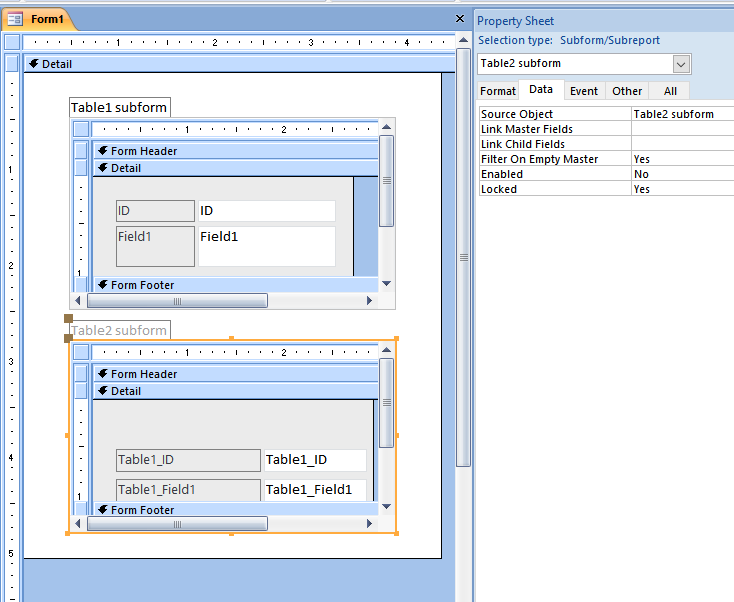
Apoi, voi construi un formular Form1 și două subformulare corespondente celor două tabele, Table1 subform și Table2 subform. Acestea vor putea arăta astfel:
Then I will build a Form1 form and two subforms corresponding to the two tables, Table1 subform and Table2 subform. They will look like this:
Sursele datelor pentru Tabel1 subform și Tabel2 subform sunt
SELECT [Table1].[ID], [Table1].[Field1] FROM Table1;
respectiv
SELECT Table2.Table1_ID, Table2.Table1_Field1 FROM Table2;
Data sources for Table1 subform and Table2 subform are
SELECT [Table1]. [ID], [Table1]. [Field1] FROM Table1;
respectively
SELECT Table2.Table1_ID, Table2.Table1_Field1 FROM Table2;
Ca să fie evitate orice erori de introducere, Table2 subform nu trebuie să permită scrierea. Puteți seta proprietățile controlului care conține subformularul Enabled = No sau Locked = Yes.
In order to avoid any input errors, Table2 should not allow writing. You can set Enabled = No or Locked = Yes for the control properties that contain the subform.
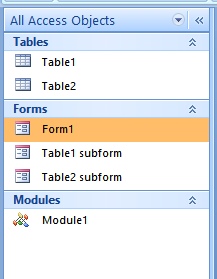
Acum, obiectele bazei de date vor arăta astfel:
Now, the database objects will look like this:
În Module1 voi scrie codul pentru resetarea tabelelor după fiecare încercare:
In Module1 I will write the code to reset the tables after each attempt:
Option Compare Database
Option Explicit
Sub BackCounter()
With CurrentDb
.Execute "DELETE FROM Table1"
.Execute "DELETE FROM Table2"
.Execute "ALTER TABLE Table1 ALTER COLUMN ID COUNTER (1,1)"
End With
End Sub
În modulul subformularului Table1 subform voi scrie următorul cod, pentru evenimentele Form_AfterInsert, Form_Current și Form_Delete:
In Table1 subform VBA module I will write the following code for Form_AfterInsert, Form_Current and Form_Delete events:
Option Compare Database
Option Explicit
Private Sub Form_AfterInsert()
With Forms!Form1![Table2 subform].Form
.Recordset.AddNew
!Table1_ID = Me!ID
!Table1_Field1 = Me!Field1
.Refresh
End With
End Sub
Private Sub Form_Current()
'there is an error with OnOpen event, because Table2_subform is not initialized yet
On Error GoTo ErrEx
With Forms!Form1![Table2 subform].Form.Recordset
.MoveFirst
.Move Me.Recordset.AbsolutePosition
End With
ErrEx:
End Sub
Private Sub Form_Delete(Cancel As Integer)
Forms!Form1![Table2 subform].Form.Recordset.Delete
'after Delete, Table2 was going to the first record
'so, to make sure the both tables are on the same record, put the Table1 on the first record:
Me.Recordset.MoveFirst
End Sub
Rezultatul arată astfel:
The result looks like this:
Când se va introduce rând nou în Tabel1 subform, se va adăuga și în Tabel2 subform. Dacă se va șterge un rând din Tabel1 subform, în Tabel2 subform va fi șters rândul corespunzător.
When a new row is inserted into Table1 subform, it will be added to Table2 subform as well. Deleting a row from Table1 subform will delete the corresponding row in Table2 subform.
miercuri, 11 decembrie 2019
DAO Recordset AddNew vs. SQL INSERT INTO - which is faster?
Dincolo de orice opinie, am pus mai jos codul care are raspunsul adevarat la intrebarea din titlu.
Am ales trei situatii, am facut trei tabele (Table1, Table2, Table3), fiecare cu doua campuri (ID - AutoNumber, fieldTXT - ShortText) si am rulat un singur cod pentru a insera 100000 de inregistrari in fiecare tabel.
Beyond any opinion, I have put below the code that has the true answer to the title question.
I chose three situations, made three tables (Table1, Table2, Table3), each with two fields (ID - AutoNumber, fieldTXT - ShortText) and ran a single code to insert 100,000 records in each table.
Sub Faster()
Dim valTime1 As Long, valTime2 As Long
Dim rst As Recordset
Dim i As Long
'reset tables, just for sure, for when this code is repeated:
With CurrentDb
.Execute "ALTER TABLE Table1 ALTER COLUMN ID COUNTER (1,1)"
.Execute "ALTER TABLE Table2 ALTER COLUMN ID COUNTER (1,1)"
.Execute "ALTER TABLE Table3 ALTER COLUMN ID COUNTER (1,1)"
End With
valTime1 = Time * 86400
Set rst = CurrentDb.OpenRecordset("Table1")
For i = 1 To 100000
rst.AddNew
rst!fieldTXT = "123456789101112131415161718192021222324252627282930"
rst.Update
Next i
rst.Close
Set rst = Nothing
valTime2 = Time * 86400
Debug.Print "DAO Recordset: ", valTime2 - valTime1
valTime1 = Time * 86400
For i = 1 To 100000
CurrentDb.Execute "INSERT INTO Table2 (fieldTXT) VALUES ('123456789101112131415161718192021222324252627282930')"
Next i
valTime2 = Time * 86400
Debug.Print "SQL INSERT single row: ", valTime2 - valTime1
valTime1 = Time * 86400
CurrentDb.Execute "INSERT INTO Table3 (fieldTXT) SELECT fieldTXT FROM Table1"
valTime2 = Time * 86400
Debug.Print "SQL INSERT multiple rows: ", valTime2 - valTime1
End Sub
rezultatul apare in Immediate Window (in secunde):
the result appears in the Immediate Window (in seconds):
DAO Recordset: 12
SQL INSERT single row: 61
SQL INSERT multiple rows: 0
joi, 28 noiembrie 2019
The folder contents - VB Script
Dacă aveți nevoie să scoateți rapid un raport în care să existe conținutul unui folder, puteți folosi VB Script. Următorul cod va genera un fișier .csv. Se poate folosi Microsoft Excel pentru deschidere.
Pentru departajarea coloanelor, datorită setărilor locale se va putea folosi alternativ "," sau ";".
If you need to quickly extract a report with a certain folder contents, you may use VB Script. The following code will generate a .csv file. You may use Microsoft Excel to open it.
For the separation of the columns, due to the local settings it will be possible to use alternatively "," or ";".
'source: https://code-for-vb.blogspot.com/2019/11/the-folder-contents-vb-script.html
'please to mention
Dim Fol
Dim sFol
Dim Fil
Dim strPath
Dim fso
Dim objShell
Dim MyFile
Dim CurrentDirectory
Const ForReading = 1, ForWriting = 2, ForAppending = 8
Const TristateUseDefault = -2, TristateTrue = -1, TristateFalse = 0
Set fso = CreateObject("Scripting.FileSystemObject")
CurrentDirectory = fso.GetAbsolutePathName(".")
Set objShell=CreateObject("WScript.Shell")
strPath = InputBox("Input the folder address:")
On Error Resume Next
Set Fol = fso.GetFolder(strPath)
If Err.Number <> 0 Then
Eroare()
WScript.Quit
End if
On Error GoTo 0
If fso.FileExists(CurrentDirectory & "\txtStructList.csv") Then fso.DeleteFile(CurrentDirectory & "\txtStructList.csv")
Set MyFile = fso.OpenTextFile(CurrentDirectory & "\txtStructList.csv", ForAppending, True, TristateUseDefault)
MyFile.WriteLine "Name , Type , Date created , Date modified , Date accessed , Files number , Subfolders number , Size"
For Each sFol In Fol.SubFolders
MyFile.WriteLine sFol.Name & " , folder , " & sFol.DateCreated & " , " & sFol.DateLastModified & " , " & sFol.DateLastAccessed & " , " & sFol.Files.Count & " , " & sFol.SubFolders.Count & " , " & sFol.Size & " bytes"
Next
For Each Fil In Fol.Files
MyFile.WriteLine Fil.Name & " , fisier , " & Fil.DateCreated & " , " & Fil.DateLastModified & " , " & Fil.DateLastAccessed & " , , , " & Fil.Size & " bytes"
Next
MyFile.Close
objShell.Run CurrentDirectory & "\txtStructList.csv"
Sub Eroare()
MsgBox Err.Description, vbExclamation, "ERR: " & Err.Number
End Sub
Pentru departajarea coloanelor, datorită setărilor locale se va putea folosi alternativ "," sau ";".
If you need to quickly extract a report with a certain folder contents, you may use VB Script. The following code will generate a .csv file. You may use Microsoft Excel to open it.
For the separation of the columns, due to the local settings it will be possible to use alternatively "," or ";".
'source: https://code-for-vb.blogspot.com/2019/11/the-folder-contents-vb-script.html
'please to mention
Dim Fol
Dim sFol
Dim Fil
Dim strPath
Dim fso
Dim objShell
Dim MyFile
Dim CurrentDirectory
Const ForReading = 1, ForWriting = 2, ForAppending = 8
Const TristateUseDefault = -2, TristateTrue = -1, TristateFalse = 0
Set fso = CreateObject("Scripting.FileSystemObject")
CurrentDirectory = fso.GetAbsolutePathName(".")
Set objShell=CreateObject("WScript.Shell")
strPath = InputBox("Input the folder address:")
On Error Resume Next
Set Fol = fso.GetFolder(strPath)
If Err.Number <> 0 Then
Eroare()
WScript.Quit
End if
On Error GoTo 0
If fso.FileExists(CurrentDirectory & "\txtStructList.csv") Then fso.DeleteFile(CurrentDirectory & "\txtStructList.csv")
Set MyFile = fso.OpenTextFile(CurrentDirectory & "\txtStructList.csv", ForAppending, True, TristateUseDefault)
MyFile.WriteLine "Name , Type , Date created , Date modified , Date accessed , Files number , Subfolders number , Size"
For Each sFol In Fol.SubFolders
MyFile.WriteLine sFol.Name & " , folder , " & sFol.DateCreated & " , " & sFol.DateLastModified & " , " & sFol.DateLastAccessed & " , " & sFol.Files.Count & " , " & sFol.SubFolders.Count & " , " & sFol.Size & " bytes"
Next
For Each Fil In Fol.Files
MyFile.WriteLine Fil.Name & " , fisier , " & Fil.DateCreated & " , " & Fil.DateLastModified & " , " & Fil.DateLastAccessed & " , , , " & Fil.Size & " bytes"
Next
MyFile.Close
objShell.Run CurrentDirectory & "\txtStructList.csv"
Sub Eroare()
MsgBox Err.Description, vbExclamation, "ERR: " & Err.Number
End Sub
duminică, 17 noiembrie 2019
How Much Time Has Passed - VBA
Uneori avem nevoie sa stim cat timp a trecut intre doua date, in termeni de zile, luni si ani. Simpla scadere a datei mai mici din data mai mare nu este suficienta: numarul rezultat este doar numarul zilelor. Din nefericire, felul in care ne-am structurat timpul in zile, luni si ani nu face usor calculul in acesti termeni: luna poate avea 28, 29, 30 sau 31 de zile; intre 28 februarie si 31 martie avem o luna si 3 zile, iar odata la patru ani avem o luna si 2 zile.
Functia de mai jos simplifica lucrurile. Ea poate fi folosita ca atare. In Excel, va aparea in lista de functii si se vor putea face referinte catre celule. Variabilele declarate la nivel de modul pot fi folosite separat in alte functii sau rutine.
--------------------------------------------------------------------------------------
Sometimes we need to know how much time has elapsed between two dates, in terms of days, months and years. Simply subtracting the smaller date from the larger date is not enough: the resulting number is just the number of days. Unfortunately, the way we have structured our time in days, months and years does not make the calculation easy in these terms: the month can be 28, 29, 30 or 31 days; between February 28 and March 31 we have a month and 3 days, and every four years we have a month and 2 days.
The function below simplifies things. It may be used as such. In Excel, it will appear in the list of functions and will be able to make references to cells. The variables declared at the module level can be used separately in other functions or routines.
'source: https://code-for-vb.blogspot.com/2019/11/how-much-time-has-passed.html
'please to mention
Option Explicit
Public y As Integer, m As Byte, d As Byte
Public Function TimeSTR(ByRef DataStart As Date, ByRef DataEnd As Date) As String
Dim yearStart As Integer, yearEnd As Integer
Dim monthStart As Byte, monthEnd As Byte
Dim dayStart As Byte, dayEnd As Byte
Dim dayMonthFinal As Byte
Dim inReverse As Boolean, TemporarData As Date
If DataStart = 0 Or DataEnd = 0 Then
TimeSTR = "no begining / ending date"
Exit Function
End If
10
Select Case DataEnd >= DataStart
Case True
yearStart = Year(DataStart)
yearEnd = Year(DataEnd)
monthStart = Month(DataStart)
monthEnd = Month(DataEnd)
dayStart = Day(DataStart)
dayEnd = Day(DataEnd)
Case False
inReverse = True
TemporarData = DataStart
DataStart = DataEnd
DataEnd = TemporarData
GoTo 10
End Select
'finding leap years and odd or even months
Select Case monthEnd
Case 1, 3, 5, 7, 8, 10, 12 '31 days
dayMonthFinal = 31
Case 2 'February - see leap years
Select Case yearEnd Mod 4
Case 0
dayMonthFinal = 29
Case Else
dayMonthFinal = 28
End Select
Case 4, 6, 9, 11 '30 days
dayMonthFinal = 30
End Select
'y=years
'm=months
'd=days
Select Case yearStart = yearEnd
Case True 'year
Select Case monthStart = monthEnd
Case True 'month
y = 0
m = 0
d = dayEnd - dayStart
Case False 'month
Select Case dayEnd >= dayStart
Case True 'day
y = 0
m = monthEnd - monthStart
d = dayEnd - dayStart
Case False 'day
y = 0
m = monthEnd - monthStart - 1
d = dayEnd + dayMonthFinal - dayStart
End Select 'day
End Select 'month
Case False 'year
Select Case monthEnd >= monthStart
Case True 'month
Select Case dayEnd >= dayStart
Case True 'day
y = yearEnd - yearStart
m = monthEnd - monthStart
d = dayEnd - dayStart
Case False 'day
Select Case monthStart = monthEnd
Case True 'month
y = yearEnd - yearStart - 1
m = 11 '(12-1)
d = dayEnd + dayMonthFinal - dayStart + 1
Case False 'month
y = yearEnd - yearStart
m = monthEnd - monthStart - 1
d = dayEnd + dayMonthFinal - dayStart
End Select 'month
End Select 'day
Case False 'month
Select Case dayEnd >= dayStart
Case True 'day
y = yearEnd - yearStart - 1
m = 12 - monthStart + monthEnd
d = dayEnd - dayStart
Case False 'day
y = yearEnd - yearStart - 1
m = 12 - monthStart + monthEnd - 1
d = dayEnd + dayMonthFinal - dayStart
End Select 'day
End Select 'month
End Select 'year
TimeSTR = y & " years, " & m & " months, " & d & " days" & IIf(inReverse, " in reverse", "")
End Function
Functia de mai jos simplifica lucrurile. Ea poate fi folosita ca atare. In Excel, va aparea in lista de functii si se vor putea face referinte catre celule. Variabilele declarate la nivel de modul pot fi folosite separat in alte functii sau rutine.
--------------------------------------------------------------------------------------
Sometimes we need to know how much time has elapsed between two dates, in terms of days, months and years. Simply subtracting the smaller date from the larger date is not enough: the resulting number is just the number of days. Unfortunately, the way we have structured our time in days, months and years does not make the calculation easy in these terms: the month can be 28, 29, 30 or 31 days; between February 28 and March 31 we have a month and 3 days, and every four years we have a month and 2 days.
The function below simplifies things. It may be used as such. In Excel, it will appear in the list of functions and will be able to make references to cells. The variables declared at the module level can be used separately in other functions or routines.
'source: https://code-for-vb.blogspot.com/2019/11/how-much-time-has-passed.html
'please to mention
Option Explicit
Public y As Integer, m As Byte, d As Byte
Public Function TimeSTR(ByRef DataStart As Date, ByRef DataEnd As Date) As String
Dim yearStart As Integer, yearEnd As Integer
Dim monthStart As Byte, monthEnd As Byte
Dim dayStart As Byte, dayEnd As Byte
Dim dayMonthFinal As Byte
Dim inReverse As Boolean, TemporarData As Date
If DataStart = 0 Or DataEnd = 0 Then
TimeSTR = "no begining / ending date"
Exit Function
End If
10
Select Case DataEnd >= DataStart
Case True
yearStart = Year(DataStart)
yearEnd = Year(DataEnd)
monthStart = Month(DataStart)
monthEnd = Month(DataEnd)
dayStart = Day(DataStart)
dayEnd = Day(DataEnd)
Case False
inReverse = True
TemporarData = DataStart
DataStart = DataEnd
DataEnd = TemporarData
GoTo 10
End Select
'finding leap years and odd or even months
Select Case monthEnd
Case 1, 3, 5, 7, 8, 10, 12 '31 days
dayMonthFinal = 31
Case 2 'February - see leap years
Select Case yearEnd Mod 4
Case 0
dayMonthFinal = 29
Case Else
dayMonthFinal = 28
End Select
Case 4, 6, 9, 11 '30 days
dayMonthFinal = 30
End Select
'y=years
'm=months
'd=days
Select Case yearStart = yearEnd
Case True 'year
Select Case monthStart = monthEnd
Case True 'month
y = 0
m = 0
d = dayEnd - dayStart
Case False 'month
Select Case dayEnd >= dayStart
Case True 'day
y = 0
m = monthEnd - monthStart
d = dayEnd - dayStart
Case False 'day
y = 0
m = monthEnd - monthStart - 1
d = dayEnd + dayMonthFinal - dayStart
End Select 'day
End Select 'month
Case False 'year
Select Case monthEnd >= monthStart
Case True 'month
Select Case dayEnd >= dayStart
Case True 'day
y = yearEnd - yearStart
m = monthEnd - monthStart
d = dayEnd - dayStart
Case False 'day
Select Case monthStart = monthEnd
Case True 'month
y = yearEnd - yearStart - 1
m = 11 '(12-1)
d = dayEnd + dayMonthFinal - dayStart + 1
Case False 'month
y = yearEnd - yearStart
m = monthEnd - monthStart - 1
d = dayEnd + dayMonthFinal - dayStart
End Select 'month
End Select 'day
Case False 'month
Select Case dayEnd >= dayStart
Case True 'day
y = yearEnd - yearStart - 1
m = 12 - monthStart + monthEnd
d = dayEnd - dayStart
Case False 'day
y = yearEnd - yearStart - 1
m = 12 - monthStart + monthEnd - 1
d = dayEnd + dayMonthFinal - dayStart
End Select 'day
End Select 'month
End Select 'year
TimeSTR = y & " years, " & m & " months, " & d & " days" & IIf(inReverse, " in reverse", "")
End Function
marți, 29 octombrie 2019
Normalizing Fields - VBA Access
MS Access permite campuri cu valori multiple, ceea ce nu este intotdeauna potrivit. In cazul in care tabelele nu sunt folosite ca atare, pentru programator nu este nici un avantaj sa aiba campuri cu valori multiple. Tot ceea ce are de facut, este sa normalizeze datele prin atomizarea campurilor.
MS Access allows multiple values fields, which is not always appropriate. If the tables are not used as it is, there is no advantage for the programmer to having fields with multiple values. All he has to do is normalize the data by atomizing the fields.
De exemplu, avem un tabel unde codificam grupurile de utilizatori.
For example, we have a table where we code the users groups.

Si un tabel cu utilizatori si grupurile din care fac parte. Un utilizator poate face parte din mai multe grupuri.
And a table with users and the groups they belong to. A user may be part of several groups.

Sursa campului GroupID arata astfel:
The source of the GroupID field looks like this:

Pentru atomizare, folositi acest cod:
For atomization, use this code:
'source: https://code-for-vb.blogspot.com/2019/10/normalizing-fields-vba-access.html
'please to mention
Sub ColumnsAtomization()
Dim rst_1 As Recordset
Dim rst_2 As Recordset
Dim str() As String
Dim aaa As String
Dim i As Integer
CurrentDb.Execute "CREATE TABLE [Users_New] (UserID INTEGER, UserName TEXT(20), GroupID INTEGER)"
Set rst_2 = CurrentDb.OpenRecordset("Users_New")
Set rst_1 = CurrentDb.OpenRecordset("Users")
Do
aaa = DLookup("GroupID", "Users", "UserID = " & rst_1!UserID)
str = Split(aaa, ", ") 'or str = Split(aaa, "; ") - depends on regional settings
For i = 0 To UBound(str)
rst_2.AddNew
rst_2!UserID = rst_1!UserID
rst_2!UserName = rst_1!UserName
rst_2!GroupID = str(i)
rst_2.Update
Next i
rst_1.MoveNext
Loop Until rst_1.EOF = True
Set rst_1 = Nothing
Set rst_2 = Nothing
End Sub
MS Access allows multiple values fields, which is not always appropriate. If the tables are not used as it is, there is no advantage for the programmer to having fields with multiple values. All he has to do is normalize the data by atomizing the fields.
De exemplu, avem un tabel unde codificam grupurile de utilizatori.
For example, we have a table where we code the users groups.

Si un tabel cu utilizatori si grupurile din care fac parte. Un utilizator poate face parte din mai multe grupuri.
And a table with users and the groups they belong to. A user may be part of several groups.

Sursa campului GroupID arata astfel:
The source of the GroupID field looks like this:

Pentru atomizare, folositi acest cod:
For atomization, use this code:
'source: https://code-for-vb.blogspot.com/2019/10/normalizing-fields-vba-access.html
'please to mention
Dim rst_1 As Recordset
Dim rst_2 As Recordset
Dim str() As String
Dim aaa As String
Dim i As Integer
CurrentDb.Execute "CREATE TABLE [Users_New] (UserID INTEGER, UserName TEXT(20), GroupID INTEGER)"
Set rst_2 = CurrentDb.OpenRecordset("Users_New")
Set rst_1 = CurrentDb.OpenRecordset("Users")
Do
aaa = DLookup("GroupID", "Users", "UserID = " & rst_1!UserID)
str = Split(aaa, ", ") 'or str = Split(aaa, "; ") - depends on regional settings
For i = 0 To UBound(str)
rst_2.AddNew
rst_2!UserID = rst_1!UserID
rst_2!UserName = rst_1!UserName
rst_2!GroupID = str(i)
rst_2.Update
Next i
rst_1.MoveNext
Loop Until rst_1.EOF = True
Set rst_1 = Nothing
Set rst_2 = Nothing
End Sub
Abonați-vă la:
Postări (Atom)